PART 1 – MODE OF THINKING
ANALYZE THE CONTENT FIRST
Before starting to read a book or article, analyse/observe the chapters that compose it, the images, the diagrams…
You need this to process what you have seen and make you better understand what you will read.
FOCUSED THOUGHT VS WIDESPREAD THINKING
We alternate these modes frequently during our daily activities.
We use one or the other unconsciously and at the same time.
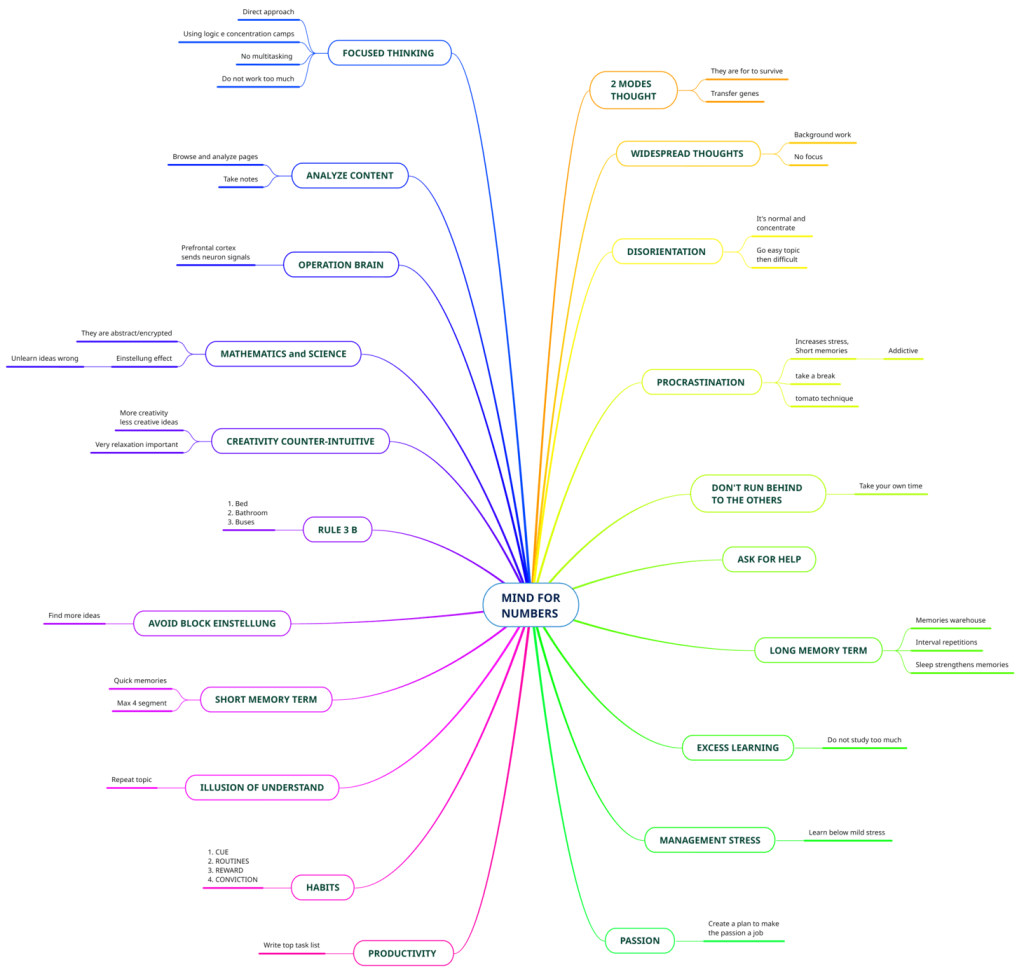
FOCUSED THINKING
It means approaching problem solving directly using logic, sequentiality and analyticity.
It is associated with the concentration abilities of the prefrontal cortex.
WIDESPREAD THOUGHTS
He is capable of working in the background on something you are not focused on.
This is what happens when you release your attention and let your mind wander. This relaxation allows different areas of the brain to connect with each other and provide you with valuable insights.
BRAIN FUNCTION
When you focus on something, your prefrontal cortex, alert and aware, sends signals along pathways between neurons.
This process resembles an octopus that spreads its tentacles around itself to tinker with anything that comes within range.
WHY ARE MATHEMATICS AND SCIENCE DIFFICULT TO LEARN?
Because they’re abstracted and encrypted and it adds a layer of complexity.
There is another challenge related to the difficulties of learning mathematics and science. It is called the Einstellung effect.
In this phenomenon, an idea that you already have in mind, or just your initial thought, gets in the way of coming to a better idea or better solution.
This kind of wrong approach is very easy to have in science, due to the fact that sometimes the initial intuition about what is happening is misleading.
You will have to unlearn previous misconceptions as you learn new ones.
One of the biggest mistakes students sometimes make is jumping into the water without first learning how to swim.
In other words, blindly starting to work on homework without first reading the textbook, or listening to lectures, or watching video lectures online, or talking to someone who knows the subject.
This is the recipe for poaching.
COUNTER-INTUITIVE CREATIVITY
The more you try to get something creative out of your brain, the less creative your ideas will be.
Relaxation is an important part of your hard work and a job well done.
WHY ARE THERE 2 MODES OF THINKING?
The answer may be related to the two main problems that vertebrates had to face and overcome in order to stay alive and transfer their genes to their progeny.
EX: birds peck at food (therefore they focus) and occasionally stop to check for predators.
EMBRACE DISORIENTATION/CONFUSION
It’s normal to get disoriented when learning a new topic because it’s part of the learning process.
So DON’T GIVE UP at the beginning saying you’re not capable, focus more and move on.
PART 2 – DON’T WASTE YOUR TIME
PROCRASTINATION
Procrastination raises your stress levels because you know you have something to complete.
It is useless for learning because studying the subject in a short time creates weak and fragmented neural pathways that will quickly disappear.
HOW TO DEFEAT PROCRASTINATION
Turn off or silence things that distract you like phone notifications, then use the Pomodoro technique, i.e. activate a 25 minute timer and do the work you want to do, then when the timer is up activate another 5 minute timer to rest (this is for the more experienced) or do something you like like going on social media… (this is for the more procrastinators).
ADVANCED VERSION
If you want to apply a more advanced version of this approach, imagine that at the end/during the day you are reflecting on one of the tasks you have done.
What was this task or set of tasks?
Write it down in writing in list form. So work on it. Try to complete at least three 25-minute sessions on whatever task you deem important.
At the end of the working day look at what you managed to cross off the list as completed and savor how accomplished you feel.
Then write down some other things you would like to work on tomorrow. This advance preparation will help the widespread mode start thinking about how to do these tasks when you get to work tomorrow.
PAUSE AND REMEMBER
Close and look away from reading. What are the main ideas of what you read?
Don’t worry if you don’t remember much when you first do it.
If you keep practicing this technique, you’ll start to notice changes in the amount of information you recall from memory.
HOW TO SWITCH FROM FOCUSED TO DIFFUSE MODE
For most people, the transition from focused to diffuse mode happens naturally if you get distracted and let some time pass like going for a walk.
3 B RULE:
- Bed (to rest)
- Bath (take a bath)
- Bus, walk.. (take a ride)
When you’re distracted from the problem at hand, the widespread mode is activated to reach a solution.
After you’ve made an interruption, when you come back to the problem, the solution will suddenly appear.
“I have not failed. I just found ten thousand ways it doesn’t work” – Thomas Edison
USE THESE DIFFUSE MODE TOOLS AS A REWARD AFTER WORK IN FOCUSED MODE
- Sleep
- Go to the gym
- Play a sport
- Walk, run
- Take a car ride
- Take a shower
- Play songs you know well on a musical instrument
- Meditate
The following pervasive mode triggers work best when used sparingly, as perks:
- Play video games
- Surf the web
- Talk to friends
- Volunteer to help with a simple job
- Read a relaxing book
- Message friends
- Go to the cinema or play
- He watches TV
DON’T RUN AFTER OTHERS
There are people who are better suited for certain subjects, if you are not, don’t try to reach them by studying more, YOU MUST TAKE YOUR TIME!!
AVOID THE EINSTELLUNG BLOCK
Remember, the first idea that comes to your mind when you’re working on an assignment or problem can prevent you from coming up with a better solution.
ASK FOR HELP
When you’re seriously stuck, there’s nothing better than getting some pointers from your classmates, your peers, or the instructor…
Ask someone else for a different perspective on how to solve the problem, or a different analogy to understand the concept.
PART 3 – TYPES OF MEMORIES
SHORT-TERM MEMORY
Short-term memory is that part of memory that deals with what you are consciously processing in your mind right now.
Our mind only holds about 4 segments of information.
When you master a technique or concept in math or science, it takes up less space in our short-term memory.
This frees up space for thought which can then join other ideas.
LONG-TERM MEMORY
Long-term memory is like a warehouse. When the elements go in, they stay there.
Research has shown that when your brain first holds a piece of information in long-term memory, you’ll need to revisit it a few times to increase the likelihood of finding it again when you need it later.
HOW TO PASS INFORMATION FROM SHORT-TERM MEMORY TO LONG-TERM
To help this process, use a technique called spaced repetition.
This technique involves repeating what you are trying to remember.
Interspersing this repetition over several days.
OVERCOME A DIFFICULT PROBLEM
Next time you’re tackling a tough problem, when you get stuck, go to another problem.
Your diffuse mode can keep working on the hard problem behind the scenes.
THE IMPORTANCE OF SLEEP
During sleep, your cells shrink, causing a dramatic increase in the space between cells.
This allows you to eliminate toxins while keeping your brain healthy and strengthen your memories.
If you sleep little toxins do not make you think clearly and can lead to depression, Alzheimer’s and prolonged sleep deprivation is lethal.
HOW TO TAKE NOTES
When underlining text, practice looking for the main ideas before making any marks, and keep the marks on the text to a minimum, one sentence or less per paragraph.
Words or footnotes that summarize key concepts are a good idea.
THE ILLUSION OF HAVING UNDERSTOOD
Students often mistakenly believe that they learn by simply re-reading the material on the page in front of them. They have an illusion of competence because the solution is there in front of them.
Pick a math or science concept from your notes or a book page. Read it, then look away from the page and see what you remember. So look at the page, re-read the concept and try again.
EXCESS OF LEARNING
Continuing the study or practice of that session after you understand what it is about is futile.
“As soon as you understand ‘topic X’, you should move on to something else and come back to ‘topic X’ another day”
WHY PROCRASTINE?
Procrastination is similar to addiction. It offers temporary excitement and relief from boring reality.
It’s easy to delude yourself that the most profitable way to use your time is to browse the Web/social media looking for information, instead of reading a textbook.
Come up with irrational excuses that seem reasonable on the surface: “If I study too long before the test, I’ll forget everything.”
PART 4 – HABITS AND PRODUCTIVITY
HABITS
Habits can be good or bad. It’s habit, when our brain starts the pre-programmed “zombie” mode
4 PARTS OF THE HABITS:
- THE SPEAK, engages the “zombie mode” and is neither helpful nor harmful.
- THE ROUTINE, this is your zombie mode, the response your brain is used to providing when prompted.
- THE REWARD, habits develop and persist because they reward us, they give us a pinch of pleasure.
- THE CONVICTION, habits have power based on how convinced you are of them.
To change a habit, you have to change the belief that you have formed within you.
SOLUTIONS TO BAD HABITS:
- THE SPEAK
Recognize what triggers your procrastination zombie mode. Cues usually fall into one of the following categories: place, time, mood, reactions to other people, or something that just happened.
EX: You can prevent more harmful cues by turning off your cell phone or staying off the Internet for short periods of time.
- THE ROUTINE
Your brain wants to automatically activate this routine as soon as you get the cue, so this is the pressure point you need to focus on to re-route old habits. The key is to have a plan.
Use the Pomodoro Technique.
- THE REWARD
Why are you procrastinating?
Can you use emotional compensation as a substitute?
A feeling of pride in having achieved something, however small?
A sense of satisfaction?
And will you give yourself a bigger reward for a bigger goal achieved?
- THE BELIEF
The most important part of changing your procrastination habit is believing you can do it. You may find that when your journey becomes stressful, you long to return to your old, more comfortable habits.
DO NOT GIVE UP!
FOCUS ON THE PROCESS NOT THE PRODUCT
If you find yourself avoiding certain activities because they make you uncomfortable, there’s a great way to reframe things: Learn to focus on the process, not the product.
Process means the flow of time and the habits and actions associated with it. Product is a result such as a task that you need to finish.
MANAGING STRESS
Research has found something fascinating and counterintuitive. If you learn under mild stress, you will be able to handle greater stresses more easily.
EX: Golfers who practice in front of other people are not upset when they have to play in front of an audience later in competition.
MULTITASKING IS HARMFUL
This kind of constant shifting of your focus causes new ideas and new concepts to become more fragile.
HOW TO BE PRODUCTIVE
The best way to gain control of habits is simple: Once a week, write a short list of your top activities.
Every day, therefore, write a list of activities that you can reasonably work on and that you can complete. Try writing this daily list the night before.
Make it five to ten entries. Try not to add anything to the daily list after you’ve created it unless it includes something unexpected but important.
Do the most important and least pleasant things first when you wake up.
If you don’t do this the tasks will occupy your working memory.
FAR DEADLINES
Turn distant deadlines into daily deadlines. Work on it piece by piece. Big tasks need to be broken down into smaller tasks, which can appear on your daily list.
DO NOT WORK TOO MUCH
People who make a habit of working long hours are much less productive overall than those who generally do their job in a reasonable and limited amount of time.
Staying too long in the work zone will drive you towards exhaustion.
PASSION AND RATIONALITY
People who leave everything and dedicate themselves totally to their passion without first reflecting on the choice are more unhappy with their career choices than those who have combined passion and rationality.
First create an ACTION PLAN by reflecting well and then follow your passion.
We develop passion in the things we are good at. The mistake is thinking that if we’re not good at something, we don’t have and never will have a passion for that thing.
MAPPA MENTALE