BOOK CARD
- Original title: Deep work
- Author: Cal Newport
- Category: Personal growth
PART 1 – FOCUS IS PRECIOUS
HOW TO BE A SUCCESSFUL PERSON IN THIS WORLD?
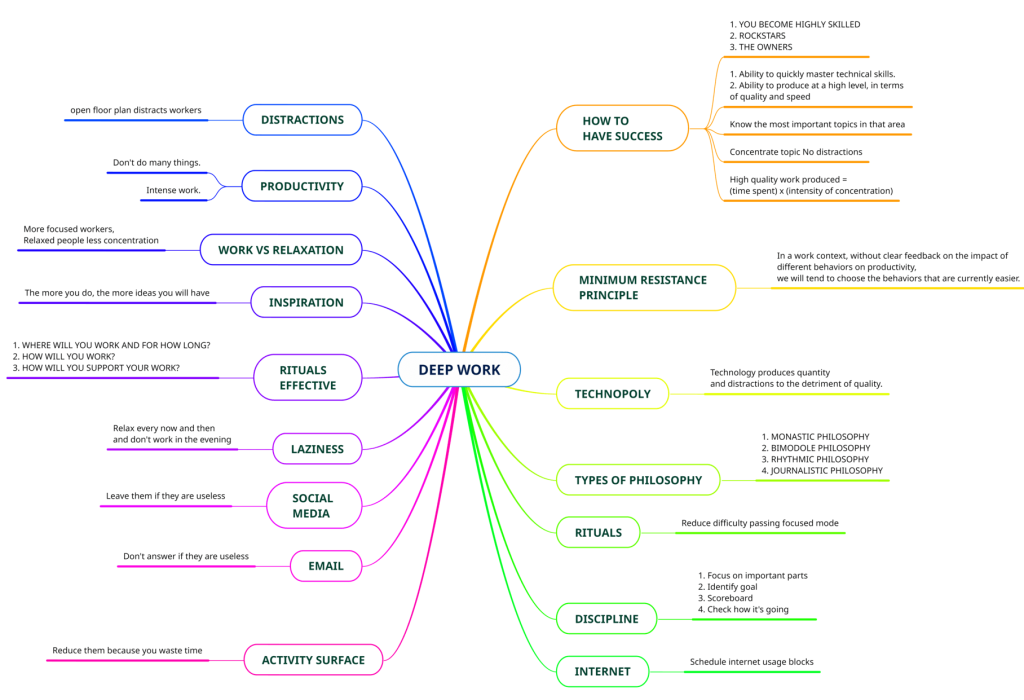
- YOU BECOME A HIGHLY SKILLED WORKER so they can’t replace you
- ROCKSTAR those people who attract work because they are famous enough in that field to them because they are good
- THE OWNERS those who have the capital to invest
SKILLS TO BE SUCCESSFUL IN THE NEW ECONOMY
- The ability to quickly master technical skills.
- The ability to produce at a high level, in terms of quality and speed.
To know and progress in one’s work environment, it is necessary to study the most important topics.
WHAT IS MYELIN AND WHY IS IT IMPORTANT
The attention is also due to the myelin which covers the neurons making them activate faster and more effectively.
Having lots of myelin helps..
Repeated use of a specific circuit triggers cells called oligodendrocytes to begin wrapping layers of myelin around the neurons in the circuits, making that ability stable and acquired.
So if you want to strengthen your neurons, you have to focus deeply on that topic and if you use social media, too many neurons are activated that mess everything up because you’re not focused.
FOCUS TO THE MAXIMUM
To acquire complex skills quickly, you need to concentrate fully, without distractions.
High quality work produced = (time spent) x (intensity of concentration)
According to Leroy’s research, when we switch from activity A to activity B, attention does not immediately switch.
Residual attention gets stuck in the previous activity. The residual is especially important if, when we engaged in activity A, our effort was not well defined and was of low intensity.
Even though we have completed activity A before moving on to anything else, our attention remains separate for a while.
PART 2 – CONCENTRATION IS RARE
DISTRACTION AT WORK
Open space offices distract workers more due to continuous noise and even the smartphone with notifications works in the same way by distracting you when you read it or because of the sound.
PRINCIPLE OF MINIMUM RESISTANCE
In a work context, without clear feedback on the impact of different behaviors on productivity, we will tend to choose the behaviors that are easier at the moment.
FRENETIC BUILDING AS A SUBSTITUTE FOR PRODUCTIVITY
In the absence of clear indicators of what it means to be productive and to realize value in their work, many knowledge workers turn to an industrial indicator of productivity, doing many things in a visible way.
We live in a technopoly, a society in which the internet and technology are the means in which governments trust the most, therefore we face a negative thing that is if you are not on the internet you do not exist and companies struggle to survive if they do not have visibility.
Busy work is a big drawback in a technopoly because it relies on values like quality, craftsmanship and expertise, which are decidedly old-fashioned and non-technological.
Worse yet, to focus at its peak often requires rejecting many technological innovations.
PART 3 – FOCUS IS IMPORTANT
AMYGDALA
In the elderly it has been seen that the amygdala is activated with positive stimuli while in young people it is activated with both positive and negative stimuli.
Older people are happier because of this.
WORK VS RELAXATION
It is thought that if we work less and relax more we will be happier, but this is not the case, because in a study it has been seen that people who work on something are more concentrated and therefore it is easier for them to get involved in what they are doing.
Empirical measurements showed that people, compared to their own expectations, were happier while working and less happy in free moments.
The content of what we focus on is important. If we pay close attention to important things and then ignore the little negative things, our working life will be more important and positive.
PART 4 - TYPES OF PHILOSOPHY
- MONASTIC PHILOSOPHY
It is the planning of the moments in which to work with maximum focus. Try to get the most out of intense effort by eliminating or drastically reducing superficial obligations.
- BIMODAL PHILOSOPHY
This philosophy asks us to divide our time to dedicate some clearly defined periods to intense and deep commitment, leaving the remainder open to other activities. In the period dedicated to intense activity, the bimodal worker will behave like the monastic worker, seeking an intense and uninterrupted concentration.
- RHYTHMIC PHILOSOPHY
The easiest way to start working with maximum concentration and continuity is to simply turn the sessions in which we focus deeply into a regular habit. The goal is to create a work rhythm that eliminates the need to invest energy in deciding if and when to work with maximum concentration.
- JOURNALISTIC PHILOSOPHY
Work a few minutes or hours on something and take a break for a few minutes or hours without thinking about work, then repeat this routine.
THE INSPIRATION
It doesn’t come at random, but it comes by doing what you like to do, so ideas increase and creativity too.
RITUALS
They reduced the difficulty of transitioning into deep concentration and allowed them to enter “intense” mode more easily and stay focused longer.
EX: Darwin studied concentrated for minutes or hours and went for a walk to reflect on his ideas then satisfied he returned to work and so on.
EFFECTIVE RITUAL TIPS:
– WHERE YOU WILL WORK AND FOR HOW LONG, the ritual must include a specific location for work efforts. The location could simply be your usual office with the door closed and the desk clear.
– HOW YOU WILL WORK, the ritual needs rules and procedures for the efforts to be framed in a structure. For example, you could institute a ban on using the Internet or maintain a unit of measurement such as the number of words written.
– HOW YOU WILL SUPPORT YOUR WORK. the ritual must support your cognitive abilities so that you can continue to work at a high level of concentration.
EX: the ritual could specify that you will start with a good cup of coffee or that you will always have something to eat that will provide you with energy.
OPEN OR CLOSED SPACES
The combination of soundproofed offices and large common spaces to which the offices are connected creates an innovative hub-and-spoke architecture, in which both serendipic encounters and intense reflection conducted in a solitary manner are favored.
It is a perfect cross between open space and enclosed space.
HOW TO HAVE DISCIPLINE
- Focus on what is of paramount importance.
The more you try to do, the less you actually get.
It is necessary to identify a small number of ambitious results that you want to pursue in the hours of intense concentration.
- Once you have identified a critically important goal, you need to measure success. There are two types of metrics, lag measures and lead measures:
Lag measures describe what we ultimately seek to improve. Lead measures, on the other hand, “measure the new behaviors that will lead to success in terms of lag measures”.
- Fill out a scoreboard that is encouraging.
Important that there is a public place to record and track lead measurements. The scoreboard creates a sense of competition that leads group members to focus on measures.
- Periodically take stock of the situation.
During matches, group members must compare their scoreboards and commit to taking specific actions to increase their score before the next match.
BE LAZY
- The theory holds that for decisions that require the application of rules rigid, the conscious mind needs to be involved.
On the other hand, for decisions that involve the collection of many different, not always clear and sometimes even conflicting information, the unconscious mind is the most suitable to deal with the question.
According to the UTT theory this happens because these regions of the brain have a wider bandwidth available, so they are able to handle more information and to examine more solutions than the possibilities of the centers of conscious thought.
- Unplugging helps us recharge the energy we need to work focused.
They validate the theory of attention regeneration, according to which spending time in nature can improve the ability to focus or chat with friends or play with children…
So don’t work in the evening but rest to be more energized the next day.
- The work you do in the evening instead of resting is usually worthless because you no longer have the energy to focus.
The concentration limit for experts is 4 hours.
PART 5 – ACCEPT BOREDOM
CONCENTRATION AND DISTRACTION
Intense Concentration: The ability to concentrate is a skill that needs to be trained.
Once the brain gets used to the distraction it’s hard to overcome the addiction even when we want to focus.
There is a ritual of regularly dedicating time usually one day a week to abstain from network technology.
Use mnemonic techniques to better remember things.
PLAN INTERNET USE
Plan in advance when you will be using the Internet and avoid surfing online outside of the established time. I suggest you keep a notebook next to your computer while you work.
On the block, record when the next time you will be able to access the Internet will be. Before that time, absolutely no connection is allowed, however tempting you are.
- This strategy also works if your job requires heavy Internet usage and a prompt response to emails.
Just respect the time slot to go offline and the online ones will be bigger for those who work with the internet.
- Regardless of how we plan the time slots we dedicate to the Internet, it is absolutely necessary to avoid using it the rest of the time.
If it happens that you are blocked because you have to look for information on the internet, don’t do it and resist because if you give in, you will enter the vortex that will eat you up.
- If we schedule the time we spend surfing online at home like we do when we work, we can improve our concentration training even more.
PART 6 – LEAVE SOCIAL MEDIA
The more you engage in low-impact activities, the lower your overall benefit will be.
QUESTIONS TO ASK WHEN YOU LEAVE SOCIAL MEDIA TEMPORARILY
- Would the last thirty days have been much more interesting or enjoyable if I had been able to access the service?
- Does anyone who hasn’t used the service care?
If the answer is “no” to both questions, leave the social network forever. If the answer is a clear yes, then come back to using it. If the answers are a qualified “yes” or if they are ambiguous, you have to decide whether to use the service again, although I recommend that you choose to abandon it.
If we want to eliminate the lure of addictive entertainment sites that consume time and attention, we need to offer the brain a quality alternative.
PART 7 – REDUCE SURFACE ACTIVITIES
SUPERFICIAL ACTIVITIES:
They are cognitively undemanding logistics-like tasks that we often perform when we are distracted. It is a type of commitment that usually does not create much added value in the world and is easily replicable.
Divide your day into chunks to be more productive.
QUALITY MESSAGES
If you want a few quality messages, put some steps to follow such as:
- Check the FAQ section to see if they have answered your similar question.
- Then have a self-created questionnaire filled out.
- Then charge a fee of money to talk to you.
By doing so you will have selected the best people with the related questions.
DO NOT REPLY TO FLAT EMAILS
When it comes to email, it’s the sender’s responsibility to convince the recipient that it’s worth responding to. If the sender fails to be convincing and minimize the effort required of the recipient to reply, there will be no reply.
DO NOT REPLY TO EMAILS IN THESE 3 CASES:
- If the message is not clear or difficult to answer.
- If it is not a question or a proposal that interests you.
- If nothing really good would happen if you answered and nothing really bad if you didn’t answer.